

Robotic-Assisted Knee Replacement in Colorado Springs, CO
Robotic-assisted knee replacement in Colorado Springs, CO combines advanced surgical technology with the experience and judgment of an orthopaedic surgeon to treat severe knee arthritis and other conditions affecting the knee joint. During robotic-assisted knee replacement, specialized technology helps the surgeon plan the procedure and accurately prepare the bone for placement of the knee implant.
Dr. Tyler Bron, MD, is a board-certified orthopaedic surgeon specializing in adult reconstruction and hip and knee conditions. His knee replacement practice includes total and partial knee replacement, revision surgery, and treatment of degenerative joint disease. He also has additional training with the Mako robotic-arm system for knee replacement.
Robotic assistance does not replace the surgeon. Instead, the technology provides additional information and guidance during selected knee replacement procedures. Whether robotic-assisted surgery is appropriate depends on your diagnosis, anatomy, imaging, symptoms, overall health, and treatment goals.
Tyler Bron, M.D.
Board-certified Orthopaedic SurgeonDr. Bron completed his fellowship in Adult Reconstruction, specializing in the treatment of arthritic hip & knee conditions at the University of Colorado in Aurora. He received specialized training in dealing with complex injuries of the hip and knee & has a particular interest in the treatment of hip arthritis through a muscle-sparing Anterior Approach. Dr. Bron works diligently with each & every patient to customize treatment plans & optimize outcomes to meet the patient’s individual goals.
What is Robotic-Assisted Knee Replacement?
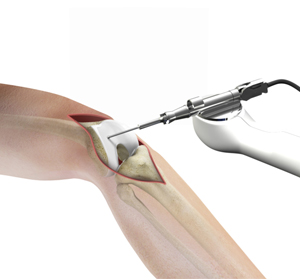
Robotic-assisted knee replacement surgery is an alternative to the conventional knee replacement procedure. It is performed using robotic-arm technology that allows your surgeon to precisely perform the surgery through a smaller incision as compared to traditional surgery.
What is Arthritis?
The knee is made up of the femur (thighbone), the tibia (shinbone) and the patella (kneecap). The two menisci, the soft cartilage between the femur and tibia, serve as a cushion and helps absorb shock during motion. Arthritis (inflammation of the joints), injury or other diseases of the joint can damage this protective layer of cartilage, causing extreme pain and difficulty in performing daily activities. Osteoarthritis is a type of arthritis.
What is Total Knee Replacement?
Total knee replacement, also called total knee arthroplasty, is a surgical procedure in which the worn out or damaged surfaces of the knee joint are removed and replaced with artificial implants.
What are the Indications for Robotic-Assisted Knee Replacement?
Robotic-assisted knee replacement is indicated if you are suffering from degenerative knee diseases such as osteoarthritis. Your doctor may recommend surgery if non-surgical treatment options have failed to relieve your symptoms.
What is the Procedure for Robotic-Assisted Knee Replacement?
The goal of total knee replacement surgery is to relieve pain and restore the alignment and function of your knee. Robotic-assisted knee replacement utilizes X-rays and CT scans to determine the damaged areas of the joint that need to be removed for the precise placement of the knee implant. Then, the damaged portions of the femur bone are cut at appropriate angles using specialized jigs. The femoral component is attached to the end of the femur with or without bone cement.
Your surgeon then cuts or shaves the damaged area of the tibia (shinbone) and the cartilage. This removes the deformed part of the bone and any bony growths, as well as creates a smooth surface on which the implants can be attached. Next, the tibial component is secured to the end of the bone with bone cement or screws.
Your surgeon will place a plastic piece between the implants to provide a smooth gliding surface for movement. This plastic insert will support the body’s weight and allow the femur to move over the tibia, like the original meniscus cartilage.
The femur and tibia with the new components are then put together to form the new knee joint.
To make sure the patella (kneecap) glides smoothly over the new artificial knee, its rear surface is also prepared to receive a plastic component. All these steps are performed with the help of the robotic arms.
With all the new components in place, the knee joint is tested through its range of motion. The entire joint is then irrigated and cleaned with a sterile solution. The incision is carefully closed; drains are inserted and a sterile dressing is placed over the incision.
What are the Benefits of Robotic-Assisted Knee Replacement?
The benefits of the robotic-assisted knee replacement include:
- Smaller incisions
- Rapid recovery
- Precise placement of the implant
- Reduced injury to adjacent tissues
- Increased longevity of the implant
Why Choose Dr. Tyler Bron for Robotic-Assisted Knee Replacement in Colorado Springs?
Choosing an orthopaedic surgeon for knee replacement involves considering experience, training, treatment options, and the approach to your individual care. Dr. Tyler Bron provides specialized joint reconstruction care for patients in Colorado Springs and surrounding communities.
- Board-certified orthopaedic surgeon: Bron is board certified by the American Board of Orthopaedic Surgery.
- Adult reconstruction fellowship training: He completed orthopaedic surgery residency training through the University of Kansas and an adult reconstruction fellowship at the University of Colorado.
- Specialized knee replacement care: His practice includes total and partial knee replacement, revision procedures, and treatment of arthritic knee conditions.
- Mako robotic-arm training: Bron has additional training with the Mako robotic-arm system for knee replacement, providing an option for technology-assisted surgery when appropriate.
- Individualized treatment planning: Not every patient requires robotic assistance or knee replacement. Dr. Bron evaluates your condition and discusses appropriate nonsurgical and surgical options.
- Patient-centered care: His approach emphasizes listening to patients, understanding their goals, maintaining open communication, and developing a treatment plan based on their individual needs.
Robotic-Assisted Knee Replacement FAQs
Robotic-assisted knee replacement is a knee replacement procedure in which specialized computer-assisted technology helps the surgeon plan and perform certain steps of the operation. The surgeon remains in control of the procedure throughout.
No. The robotic system does not independently perform the surgery. Your orthopaedic surgeon performs the procedure and uses the technology as an additional planning and surgical-assistance tool.
Robotic-assisted knee replacement may be considered for appropriately selected patients who require knee replacement because of advanced arthritis or other significant joint damage. Your surgeon will determine whether it is suitable based on your knee condition, anatomy, imaging, medical history, and goals.
Knee replacement is most commonly performed for advanced osteoarthritis. Other conditions, including inflammatory arthritis, post-traumatic arthritis, and certain types of joint damage, may also result in significant pain and loss of function requiring surgical treatment.
Before surgery, imaging and other information may be used to create an individualized surgical plan. During the procedure, the robotic-assisted system helps the surgeon with planning, bone preparation, and implant positioning. The knee is then reconstructed with the appropriate prosthetic components.
Robotic assistance may provide additional planning and positioning capabilities, but it is not automatically better for every patient. The appropriate surgical technique depends on the patient's anatomy, diagnosis, surgeon's assessment, and other factors.
Recovery varies between patients and depends on factors such as overall health, the type of procedure, physical therapy, and individual healing. Robotic assistance should not be viewed as a guarantee of faster recovery.
Potential benefits may include detailed preoperative planning and assistance with bone preparation and implant positioning. The potential advantages and limitations should be discussed with your surgeon based on your specific circumstances.
Robotic-assisted knee replacement has risks similar to other knee replacement procedures. These may include infection, blood clots, stiffness, persistent pain, implant wear or loosening, nerve or blood vessel injury, and the possibility of additional surgery. Your surgeon will review the risks and benefits with you before treatment.
Implant longevity varies depending on factors such as implant type, activity level, body weight, age, overall health, and other individual factors. Your surgeon can discuss expected implant performance and factors that may affect longevity.
Depending on the severity of arthritis and your symptoms, nonsurgical treatment may include activity modification, physical therapy, medications, weight management when appropriate, injections, and other conservative measures. Knee replacement may be considered when symptoms remain significant despite appropriate nonsurgical care.
Schedule a Robotic-Assisted Knee Replacement Consultation in Colorado Springs, CO
If knee arthritis is causing persistent pain, stiffness, or difficulty with everyday activities, an orthopaedic evaluation can help you understand your treatment options. Dr. Tyler Bron provides knee replacement care in Colorado Springs, CO, including robotic-assisted knee replacement when appropriate.
Contact Colorado Springs Orthopaedic Group to schedule a consultation with Dr. Bron and discuss whether robotic-assisted knee replacement or another treatment option may be appropriate for your knee condition.
Schedule an Appointment
Our team is here to answer your questions and help you find the right treatment for your condition.