

Knee Fracture Treatment in Colorado Springs, CO
A knee fracture can affect the bones that form or surround the knee joint and may cause significant pain, swelling, bruising, instability, and difficulty putting weight on the leg. Prompt orthopaedic evaluation is important after a suspected fracture to determine the location, severity, and stability of the injury.
At Colorado Springs Orthopaedic Group, Dr. Tyler Bron provides evaluation and treatment planning for injuries involving the knee and lower extremity. Depending on the type and severity of the fracture, treatment may include immobilization with a brace or cast, activity modification, or surgical stabilization using techniques such as plates, screws, or intramedullary nails.
If you have experienced an injury and are experiencing significant knee pain, swelling, deformity, or difficulty bearing weight, an orthopaedic evaluation can help determine the appropriate next step. Dr. Tyler Bron provides individualized orthopaedic care for patients seeking knee fracture evaluation and treatment in Colorado Springs, Colorado.
Tyler Bron, M.D.
Board-certified Orthopaedic SurgeonDr. Bron completed his fellowship in Adult Reconstruction, specializing in the treatment of arthritic hip & knee conditions at the University of Colorado in Aurora. He received specialized training in dealing with complex injuries of the hip and knee & has a particular interest in the treatment of hip arthritis through a muscle-sparing Anterior Approach. Dr. Bron works diligently with each & every patient to customize treatment plans & optimize outcomes to meet the patient’s individual goals.
What is a Knee Fracture?
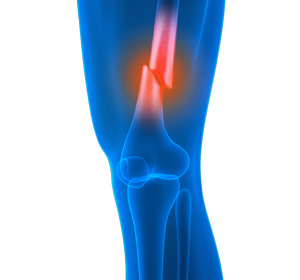
A fracture is a condition in which there is a break in the continuity of the bone. In younger individuals, these fractures are caused by high energy injuries, as from a motor vehicle accident. In older people, the most common cause is a weak and fragile bone.
Fractures of the knee can include the following:
Distal femur fracture: The distal femur is part of the femur bone that flares out like the mouth of the funnel. A distal femur (top part of knee joint) fracture is a break in the thighbone that occurs just above your knee joint.
Femoral shaft fracture: A femoral shaft fracture is a break that occurs anywhere along the femoral shaft, long, straight part of the femur.
Fractures of proximal tibia: A proximal tibial fracture is a break in the upper part of the shin bone or tibia. Proximal tibial fractures may or may not involve the knee joint. Fractures that enter the knee joint may cause joint imperfections, irregular joint surfaces, and improper alignment in the legs. This can lead to joint instability, arthritis, and loss of motion. These fractures are caused by stress or trauma or in a bone already compromised by disease, such as cancer or infection. Proximal tibia fractures can result in injury to the surrounding soft tissues including skin, muscle, nerves, blood vessels, and ligaments.
Tibial shaft fractures: A tibial shaft fracture is a break that occurs along the length of the tibia or shin bone (larger bone of the lower leg) between the knee and ankle joints. These fractures can occur while playing sports such as soccer and skiing.
How is Knee Fracture Diagnosed?
Diagnosis is made through your medical history, a physical examination, and other diagnostic imaging tests. X-rays are taken to know whether the bone is intact or broken. X-rays are also helpful to know the type and location of the fracture. Your doctor may also recommend a computerized tomography (CT) scan to know the severity of the fracture.
How is Knee Fracture Treated?
Treatment options include non-surgical and surgical. Non-surgical treatment involves skeletal traction and use of casts and braces. Skeletal traction involves placement of pin into the bone in order to realign broken bones. Surgery involves internal fixation and external fixation.
Internal fixation
Intramedullary nailing: In this procedure, a specially designed metal rod is placed into the canal of the femur. Then the nail is passed on to reach the fracture site and keep it in place. The rod is secured in place with screws at both ends.
Plates and Screws fixation: In this procedure, your surgeon will reposition the broken bone ends into normal position and then uses special screws or metal plates on the outer surface of the bone to hold the bone fragments in place.
External fixation
During the procedure, metal pins or screws are inserted into the middle of the femur and tibia and are attached to a device outside the skin to hold bone fragments in place to allow alignment and healing.
If your bone is fractured in many pieces, a plate or rod is fixed at both ends of the fracture to maintain the overall shape and length of the bone in place while it heals. In elder patients, where fracture healing delays, a bone graft taken from the patient or tissue bank may be used to form callous. In severe cases, the bone fragments are removed and the bone is replaced with a knee replacement implant.
Complications of the Surgery
The most common complications of surgery include infection, knee stiffness, delayed bone healing, and knee arthritis.
Why Choose Dr. Tyler Bron for Knee Fracture Treatment in Colorado Springs?
Knee and lower-extremity fractures can vary considerably depending on the bone involved, fracture pattern, displacement, soft-tissue injury, and overall health. Dr. Tyler Bron takes an individualized approach to evaluating orthopaedic conditions and discussing appropriate treatment options.
Patients seeking orthopaedic care in Colorado Springs may benefit from:
- Board-certified orthopaedic care: Bron is board-certified by the American Board of Orthopaedic Surgery.
- Advanced orthopaedic training: He completed orthopaedic surgery residency training and fellowship training in adult reconstruction.
- Individualized evaluation: Treatment recommendations are based on the type and severity of the injury, imaging findings, and the patient's overall condition.
- Comprehensive treatment planning: Depending on the fracture, treatment may involve nonsurgical management or surgical stabilization.
- Experience with complex joint conditions: Bron's adult reconstruction focus provides additional expertise in conditions affecting the hip and knee.
- Patient-centered care: Bron emphasizes listening to patients, understanding their goals, and maintaining open communication throughout treatment.
Knee Fracture FAQs
A knee fracture is a break in one of the bones that forms or surrounds the knee joint. Depending on the injury, a fracture may involve the distal femur, proximal tibia, or other nearby structures.
Knee fractures may result from falls, motor vehicle accidents, sports injuries, direct trauma, or other high-energy injuries. In older adults, fractures can also occur after lower-energy falls when bones have become weaker.
Symptoms may include sudden pain, swelling, bruising, tenderness, difficulty bearing weight, limited movement, or visible deformity. Symptoms depend on the location and severity of the fracture.
Diagnosis generally includes a medical history and physical examination followed by imaging. X-rays are commonly used to identify the location and pattern of a fracture. A CT scan may be recommended for more detailed assessment of complex fractures or fractures involving the joint surface.
No. Some stable or appropriately aligned fractures may be treated without surgery using immobilization, bracing, activity modification, and follow-up imaging. Surgery may be recommended when a fracture is displaced, unstable, involves the joint, or cannot be adequately managed with nonsurgical treatment.
Depending on the fracture, surgical treatment may include internal fixation with plates and screws or intramedullary nailing. Some complex injuries may require other stabilization techniques based on the specific fracture and surrounding soft-tissue condition.
A distal femur fracture occurs in the lower portion of the thighbone near the knee joint. These fractures can range from relatively simple breaks to complex injuries involving the joint surface.
A proximal tibia fracture occurs in the upper portion of the shinbone near the knee. Some fractures involve the knee joint surface and may affect alignment, stability, and long-term joint function.
Some fractures that involve the knee joint can increase the risk of developing post-traumatic arthritis, particularly when the joint surface or alignment is significantly affected. Appropriate treatment and follow-up are important for managing these injuries.
Healing time varies based on the fracture pattern, location, severity, treatment, age, bone health, and other individual factors. Your orthopaedic surgeon can provide a more individualized recovery plan after evaluating the injury.
Seek prompt medical evaluation after a significant injury if you have severe pain, substantial swelling, deformity, inability to bear weight, or difficulty moving the knee. Suspected fractures require appropriate imaging and assessment.
A suspected fracture should be evaluated by a medical professional rather than managed solely at home. Until you receive medical care, avoid putting unnecessary weight on the injured leg and follow appropriate first-aid guidance.
Schedule a Knee Fracture Evaluation in Colorado Springs, CO
A knee fracture can require timely evaluation to determine whether the bone is stable and whether nonsurgical or surgical treatment is appropriate. Dr. Tyler Bron provides individualized orthopaedic evaluation and treatment planning for patients in Colorado Springs, CO.
If you have a suspected knee fracture or are experiencing persistent symptoms after a knee injury, contact Colorado Springs Orthopaedic Group to schedule an orthopaedic evaluation.
Schedule an Appointment
Our team is here to answer your questions and help you find the right treatment for your condition.